
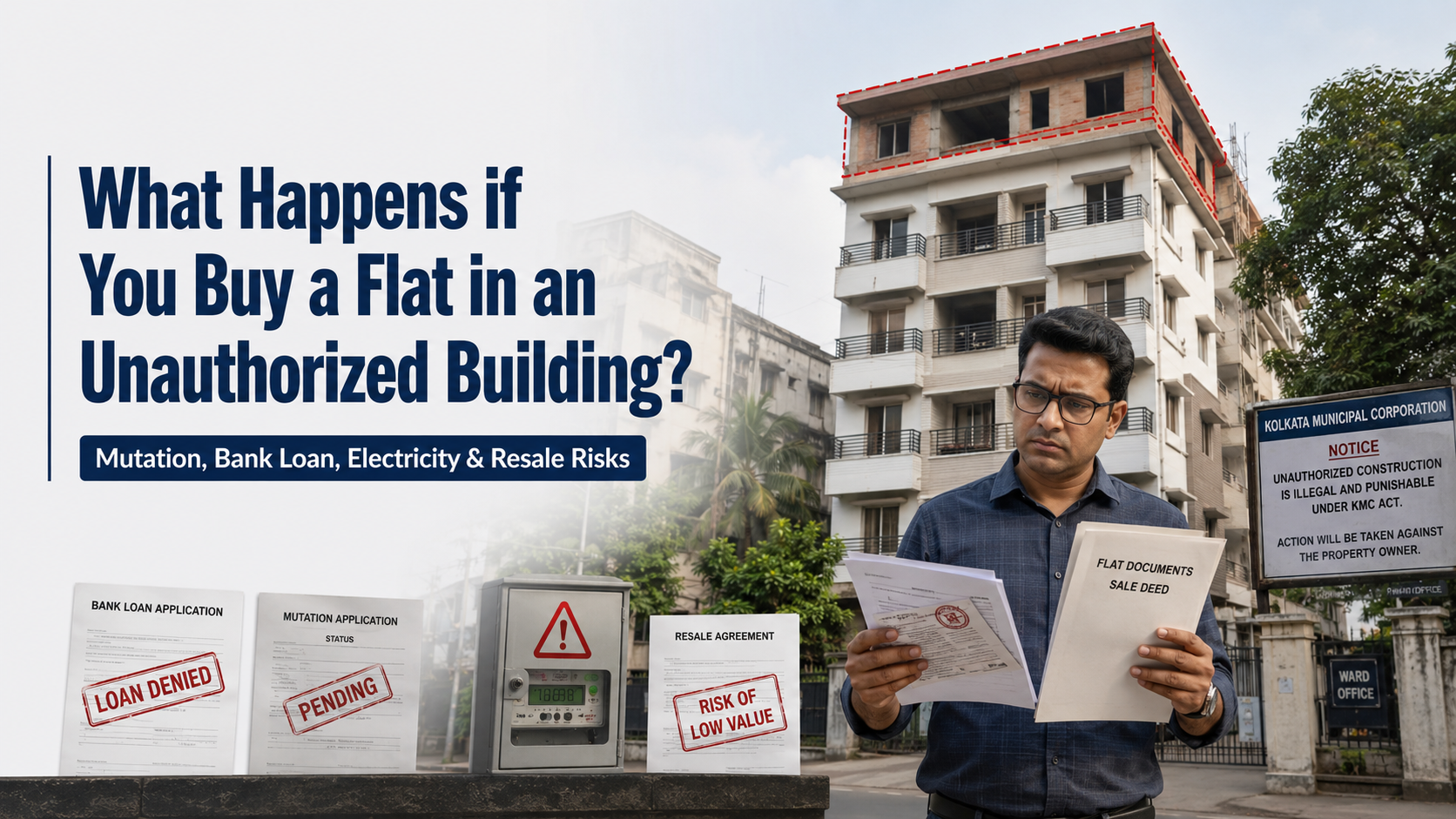

Buying a flat in Kolkata is a major financial decision. For many families, it is the result of years of savings, loan planning, and emotional investment. But one mistake can turn that dream purchase into a long legal and financial problem: buying a flat in an unauthorized building.
An unauthorized building may look complete from outside. People may already be living there. The builder may show tax receipts, electricity bills, sale deeds, or even old mutation papers. But none of these things automatically prove that the building or the flat is legally sanctioned.
In Kolkata, the Kolkata Municipal Corporation Act, 1980 gives KMC the power to act against buildings constructed without sanction, beyond the sanctioned building plan, or in violation of municipal rules. Section 400(1) allows demolition proceedings after notice and hearing, while Section 400(8) allows immediate demolition in urgent cases where reasons are recorded in writing.
So, what happens if you buy a flat in such a building? The problems can start with mutation, but they do not end there. Bank loan, electricity, water, drainage, resale, and even occupation of the flat can become difficult.
What Is an Unauthorized Building in Kolkata?
A building may be treated as unauthorized if it was constructed without a valid sanctioned plan, if extra floors were added beyond approval, if the construction violated mandatory open space rules, or if the building was occupied without proper completion or occupancy permission.
Under the KMC Act, sanction of a building plan can be refused if the proposed building, use of land, site plan, elevation, section, or specification violates the Act, rules, regulations, or any other applicable law.
This is important because many buyers only check whether the flat has a registered deed. Registration of a sale deed and legality of construction are two different things. A registered deed may prove that a transaction took place, but it does not automatically prove that the building was constructed legally.
1. Mutation May Be Denied or Restricted
Mutation is one of the first issues a buyer faces after purchasing a flat. Mutation means recording the name of the owner or person liable to pay property tax in municipal records. Many buyers assume that mutation is a simple post-purchase formality. In unauthorized buildings, it may not be simple at all.
KMC issued a circular in March 2024 requiring assessment officials to check the sanctioned building plan or completion certificate before recording mutation, assessment, apportionment, or related entries for newly built or unassessed buildings, flats, or structures. If the flat, floor, building, or portion is not sanctioned, the matter can be referred to the Building Department for a conclusive view.
The same circular says that if the structure, flat, building portion, or floor is conclusively found to be not sanctioned, the name may be recorded only as “person liable to pay tax”, and it must be clearly noted that absolute mutation directly in the name of the owner or occupier is not possible.
This is a serious issue. Being recorded as a person liable to pay tax is not the same as getting clean ownership recognition in municipal records. It also means future mutation may be blocked or flagged.
2. Paying Property Tax Does Not Legalize the Flat
Many buyers think, “If KMC accepts property tax, the flat must be legal.” This is a dangerous misunderstanding.
The KMC Act itself says that a demolition order under Section 400(1) may be made even if the building has already been assessed for property tax.
So, tax payment does not cure illegal construction. It may only show that the person is paying municipal dues. It does not prove that the building plan was sanctioned, that the floor was approved, or that the flat is safe from KMC action.
3. Bank Loan May Be Rejected
Banks usually check legal title, sanctioned building plan, completion certificate, occupancy permission, property tax records, and the chain of documents before approving a home loan. If the flat is in an unauthorized building, the bank may refuse the loan or ask for additional documents.
A flat in an illegal floor or unauthorized structure becomes risky for the bank because the security itself may be defective. If KMC later demolishes the illegal portion or refuses mutation, the value of the bank’s mortgage can fall sharply.
This is why buyers often face problems such as:
- Home loan rejection
- Lower loan eligibility
- Demand for additional legal opinion
- Delay in disbursement
- Refusal by nationalized or reputed private banks
- Dependence on private finance at higher cost
Even if one buyer somehow purchased the flat without a loan, the next buyer may not get financing. That directly affects resale value
4. Electricity Connection Can Become Complicated
Electricity is another practical issue. In a regular property transaction, a buyer expects to apply for transfer or new electricity connection after purchase. But where a building is under legal scrutiny for unauthorized construction, electricity connection may become difficult.
In one unauthorized construction matter, the court recorded that the Corporation would not supply water and sewerage connection, and CESC would not provide electric connection to the illegal constructions involved in that case.
This does not mean every unauthorized flat will automatically lose electricity immediately. But it shows the risk. If KMC proceedings, court orders, or police action begin, civic and utility connections can become part of the dispute.
A buyer may then face a flat that exists on paper but is difficult to occupy comfortably.
5. Water Supply and Drainage May Be Denied or Disconnected
This is one of the biggest practical risks. In April 2024, KMC issued a circular stating that no new water supply or drainage connection would be allowed, and existing water supply and drainage connections would be disconnected in certain unauthorized construction cases.
The circular covers cases where an entire building is detected as unauthorized and action has been taken under Section 400(8), cases where a demolition order has been passed under Section 400(1), and cases where additional floors have been constructed beyond the sanctioned plan and are not permissible.
For a flat buyer, this can create a serious living problem. Even if the flat is physically ready, lack of proper water supply or drainage can make it difficult to use, rent, or resell.
6. Resale Becomes Difficult
Unauthorized construction reduces market confidence. A future buyer may ask for the sanctioned plan, completion certificate, mutation record, tax record, and bank approval. If these documents do not match the actual flat, the deal may collapse.
Common resale problems include:
- Buyers refusing to proceed after legal verification,
- Banks refusing loan approval for the next buyer,
- Lower market price
- Longer selling time
- Demand for heavy discount
- Legal notice from buyer after discovery of illegality
- Fear of future demolition or service disconnection.
In simple terms, an unauthorized flat is not just hard to buy safely. It is also hard to sell safely.
7. There Can Be Demolition Risk
If the flat is part of an unauthorized floor or illegal construction, KMC may initiate demolition proceedings. Under Section 400(1), if a building work is done without or contrary to sanction, the Municipal Commissioner may direct demolition after giving a reasonable opportunity to show cause.
Under Section 400(8), if the Mayor-in-Council is of the opinion that immediate action is required, and reasons are recorded in writing, KMC may cause the building or work to be demolished forthwith.
This means a buyer may pay full price for a flat and later discover that the flat or floor is under demolition risk. If the illegal portion is an added floor, the risk can be even more direct because the flat itself may be the part under challenge.
8. Criminal Proceedings Are Also Possible
Unauthorized construction is not always treated as a simple municipal irregularity. In serious cases, Section 401A of the KMC Act may apply.
Section 401A covers construction of a new building or additional floors in violation of the Act or rules where such construction endangers or is likely to endanger human life, corporation property, water supply, drainage, sewerage, road traffic, or may cause fire hazard. Punishment may extend to five years’ imprisonment and fine up to ₹50,000, and the offence is cognizable and non-bailable.
This risk is usually more relevant for builders, promoters, owners, financiers, consultants, or people responsible for the construction. But buyers can still suffer the consequences if the building becomes the subject of criminal proceedings, demolition action, or court monitoring.
9. Occupancy Without Permission Is Risky
Under Section 403 of the KMC Act, after completion of a building or work, a completion notice and certificate must be submitted, and no person should occupy or permit occupation until permission has been granted by the Municipal Commissioner in accordance with the rules and regulations.
This matters because many buyers take possession just because the builder says the flat is ready. But physical possession and lawful occupation are not the same. If completion or occupancy permission is missing, the buyer may face problems later during mutation, utility connection, resale, and loan processing.
10. Builder Promises May Not Be Enough
In unauthorized building cases, builders often say things like:
“Regularization ho jayega.”
“Mutation later mil jayega.”
“Everyone in this area has same issue.”
“Tax receipt hai, no problem.”
“Electricity meter lag gaya, safe hai.”
“Registry ho jayegi, tension mat lo.”
A buyer should not rely on oral promises. If the flat is legally clear, the builder should be able to provide a sanctioned building plan, completion certificate or occupancy-related documents, approved floor details, title documents, tax records, and proof that the flat is part of the sanctioned structure.
If the builder avoids giving these documents, that itself is a warning sign.
What Should You Check Before Buying a Flat in Kolkata?
Before buying a flat in Kolkata, especially in a standalone building or small builder project, check these documents carefully:
- Sanctioned building plan,
- Whether the flat and floor are shown in the sanctioned plan
- Completion certificate or occupancy-related permission
- Mutation and assessment record
- Property tax receipts
- Title deed and chain of ownership
- Development agreement and power of attorney, if applicable,
- KMC building department records,
- Pending demolition case or stop-work notice,
- RERA registration, if applicable,
- Bank approval from reputed lenders,
- Structural stability documents, where required.
Do not check only the sale deed. The most important question is whether the flat you are buying legally exists in the approved building plan.
What If You Already Bought a Flat in an Unauthorized Building?
If you have already purchased such a flat, do not ignore the issue. Start by collecting all documents from the builder, seller, KMC records, and your own purchase file. Then get a legal opinion from a property lawyer who regularly handles KMC and real estate matters.
Depending on the facts, possible steps may include:
- Applying for certified copies of the sanctioned plan
- Checking whether the flat or floor is approved
- Verifying if any Section 400 or Section 401 proceeding exists
- Asking the builder for regularization documents, if legally possible
- Filing a complaint against the builder for misrepresentation
- Approaching consumer forum or RERA, if applicable
- Seeking civil remedies for refund, compensation, or damages
- Seeking civil remedies for refund, compensation, or damages
Regularization is not automatic. Minor deviations may sometimes be considered under applicable rules, but serious unauthorized construction, illegal extra floors, unsafe structures, or construction without sanction can be difficult or impossible to protect.
Final Thoughts
Buying a flat in an unauthorized building in Kolkata can create long-term problems. Mutation may be denied or restricted. Bank loans may fail. Electricity, water, and drainage connections may become uncertain. Resale value may fall. In serious cases, the flat may even face demolition risk.
The safest rule is simple: before paying booking money or signing the sale deed, verify whether the flat is part of the sanctioned building plan. A cheap flat without legal approval can become far more expensive than a properly approved flat.
In Kolkata, legal due diligence is not a formality. It is protection for your money, your ownership, and your future peace of mind.
FAQs
Can I get mutation for a flat in an unauthorized building in Kolkata?
You may not get clean absolute mutation if the flat, floor, or building portion is not sanctioned. KMC may record the person only as “person liable to pay tax” instead of granting normal mutation.
Does property tax receipt prove that my flat is legal?
No. Property tax payment does not legalize unauthorized construction. KMC can still proceed against illegal construction even if the property has been assessed for tax.
Can I get a bank loan for an unauthorized flat?
Usually, it is difficult. Banks may reject the loan if the sanctioned plan, title, completion certificate, or municipal records are defective.
Can KMC disconnect water and drainage for unauthorized buildings?
Yes. KMC’s April 2024 circular provides for denial of new water and drainage connections and disconnection of existing connections in specified unauthorized construction cases.
Can an unauthorized flat be resold?
It can be difficult to resell. Future buyers and banks may refuse the property after legal verification, or they may demand a heavy discount because of demolition, mutation, and service connection risks.
Can KMC demolish a flat after it is sold?
Yes, if the construction is unauthorized and action is taken under the KMC Act. Sale of the flat does not automatically protect illegal construction.
Should I buy a flat without a completion certificate?
It is risky. A completion or occupancy-related document helps show that the building was completed according to approved rules. Without it, mutation, loan, utility, and resale issues may arise.
If you are buying a flat in Kolkata or facing issues related to unauthorized construction, KMC mutation, sanctioned plan verification, demolition notices, bank loan rejection, or property due diligence, we can help. We assist buyers, flat owners, and investors with legal verification of property documents, KMC records, and builder-related disputes. For professional legal support regarding unauthorized buildings and flat verification in Kolkata, call us or contact us today.
Note: This blog is for general information only and should not be treated as legal advice. For a specific flat or KMC notice, consult a qualified property lawyer with the sanctioned plan, deed, mutation papers, and all KMC records.