
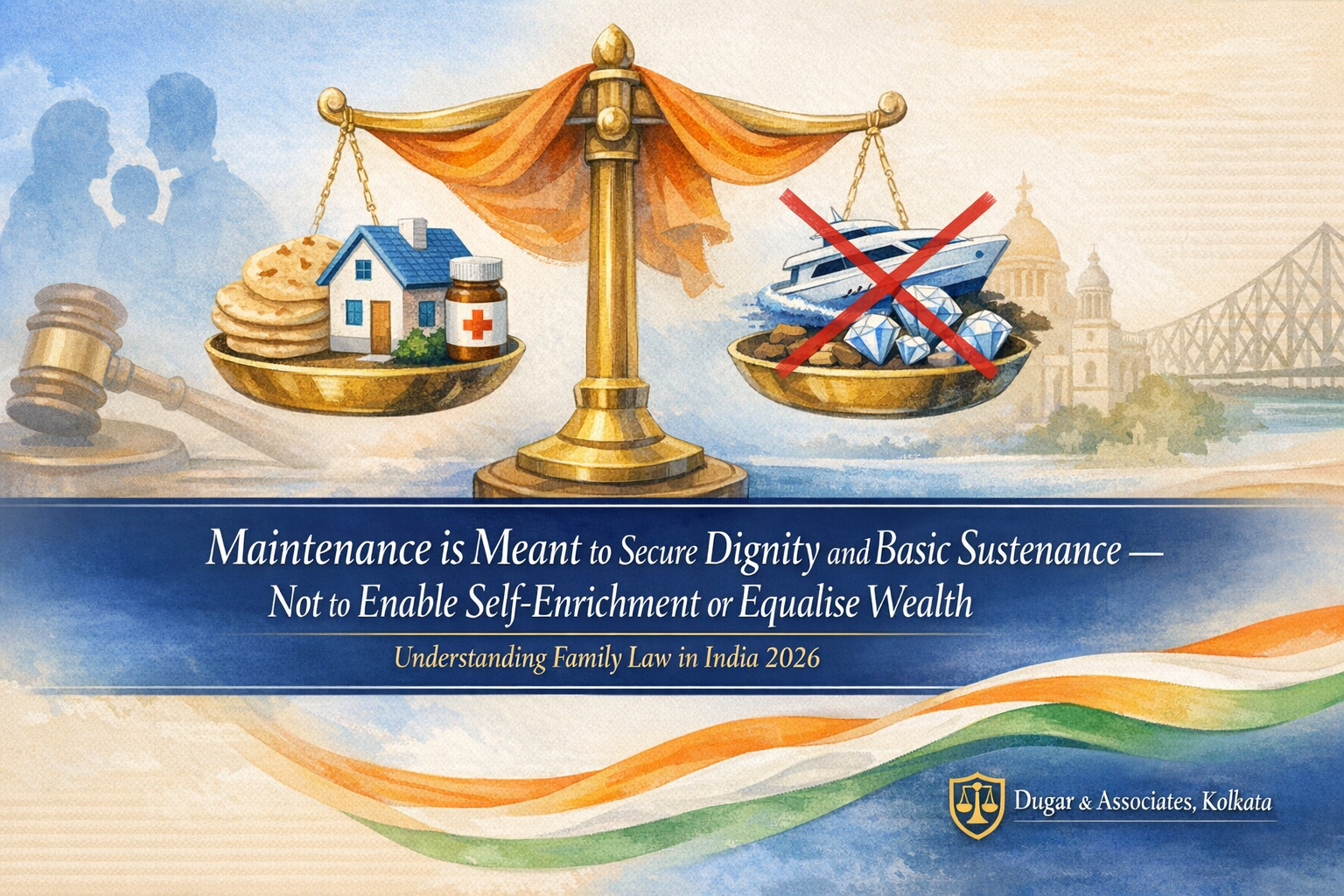

In Indian family law, maintenance serves as a vital safety net for dependent spouses and children, ensuring their basic needs are met post-separation. However, recent judicial pronouncements emphasize its true purpose: preserving dignity and providing sustenance, not facilitating luxurious lifestyles or wealth redistribution. This principle, rooted in Section 125 CrPC and personal laws, balances compassion with fairness.
Dugar & Associates, Kolkata-based experts in matrimonial and family law, frequently guide clients through these nuances at their Garcha office.
Core Purpose of Maintenance Under Indian Law
Maintenance aims to prevent vagrancy and destitution, as established in landmark cases like Bhagwan Dutt v. Kamla Devi. Courts assess the applicant’s reasonable needs against the respondent’s capacity, focusing on food, shelter, clothing, medical care, and education for children. It is not a tool for economic parity or punishment.
The Supreme Court in Rajnesh v. Neha (2020) clarified that maintenance is for “leading a comfortable life” – not extravagance. Factors include social status, employment status, and standard of living during marriage, but never to “equalize wealth.”
Judicial Guidelines Limiting Self-Enrichment
Recent rulings reinforce restraint:
Vinny Paramvir Parmar v. Paramvir Parmar (2024)
The Supreme Court criticized ₹75,000 monthly maintenance as excessive for a non-working wife, reducing it to reflect basic needs. The bench noted: “Maintenance is not to equalize financial status but secure dignity.”
Bhuwan Mohan Singh v. Meera (2015)
Awarding ₹5,000 was upheld for basic sustenance, rejecting claims for air-conditioned living beyond the couple’s marital lifestyle.
Rohatash Singh v. State of Haryana
Courts rejected luxury demands (foreign trips, designer wear), limiting to essentials matching pre-separation standards.
These judgments establish that self-enrichment via inflated claims undermines the provision’s intent.
Key Factors Courts Consider
Judges apply a structured approach per Rajnesh v. Neha guidelines:
- Applicant’s Needs: Actual expenses on housing (₹15,000-40,000 in Kolkata), food, medical insurance, children’s fees.
- Respondent’s Income: Salary slips, ITRs, business profits – not just bank statements.
- Lifestyle Parity: Reasonable upkeep, not upgrade (e.g., no 5-star equivalent for middle-class marriage).
- Duration: Interim (₹10,000-25,000/month pending trial), final awards post-proof.
- Self-Sufficiency: Working spouses receive less; homemakers get more initially.
| Factor | Purpose | Typical Kolkata Range (2026) |
|---|---|---|
| Housing | Dignified shelter | ₹20,000-50,000/month |
| Food/Clothing | Basic sustenance | ₹8,000-15,000 |
| Medical/Education | Health & child welfare | ₹10,000-30,000 |
| Litigation Costs | Access to justice | One-time ₹50,000-2 lakh |
Common Misconceptions and Pitfalls
Many seek maintenance as “alimony for life,” but courts cap it:
- Not Lifetime Guarantee: Ends on remarriage, self-sufficiency, or cohabitation.
- No Wealth Transfer: Anubha v. Vikas Aggarwal rejected equalizing husband’s business wealth.
- Double-Dipping Avoided: Can’t claim under multiple laws simultaneously without adjustment.
- Inflated Claims Backfire: Exaggerated lifestyles lead to credibility loss and cost penalties.
Kolkata courts see rising interim applications under Domestic Violence Act, but final awards average ₹20,000-40,000 monthly for middle-income cases.
2026 Updates and Enforcement Trends
Digital filing via e-Courts speeds applications (30-60 days for interim relief). Calcutta High Court emphasizes affidavits of disclosure, curbing false claims. Enforcement via salary attachments or property liens is swift, with 15% interest on arrears.
For NRIs, reciprocal agreements ensure global recovery. WB Family Courts prioritize mediation before monetary awards.
Practical Steps for Claimants and Respondents
For Applicants:
- File under Section 125 CrPC/DV Act with income proof.
- Submit detailed expense chart (not aspirational).
- Seek interim relief early.
For Respondents:
- Disclose full finances transparently.
- Prove spouse’s earning capacity.
- Opt for one-time settlement (common in Kolkata: ₹10-50 lakh).
Role of Family Courts and Mediation
Pre-litigation counseling under Family Courts Act resolves 40% cases amicably. Mediation focuses on mutual sustenance plans, avoiding adversarial wealth fights.
Why Consult Dugar & Associates
With over five years specializing in matrimonial disputes, Dugar & Associates offers compassionate yet strategic representation in divorce, maintenance, custody, and alimony matters. Our team handles Calcutta High Court appeals, negotiations, and DV Act proceedings with a client-first approach.
From drafting settlement deeds to enforcing awards, we ensure fair outcomes preserving dignity for all.
Contact Dugar & Associates:
2G, Garcha 1st Lane, Kolkata-700019 (Near Garcha Gurudwara)
Contact: +91 98318 82024 | advrahuldugar@gmail.com
Mon-Sat: 09:30 AM – 09:30 PM | https://dugarassociates.in/
Schedule a confidential consultation today. Protect your rights with expert family law guidance – because maintenance should uplift, not exploit.