
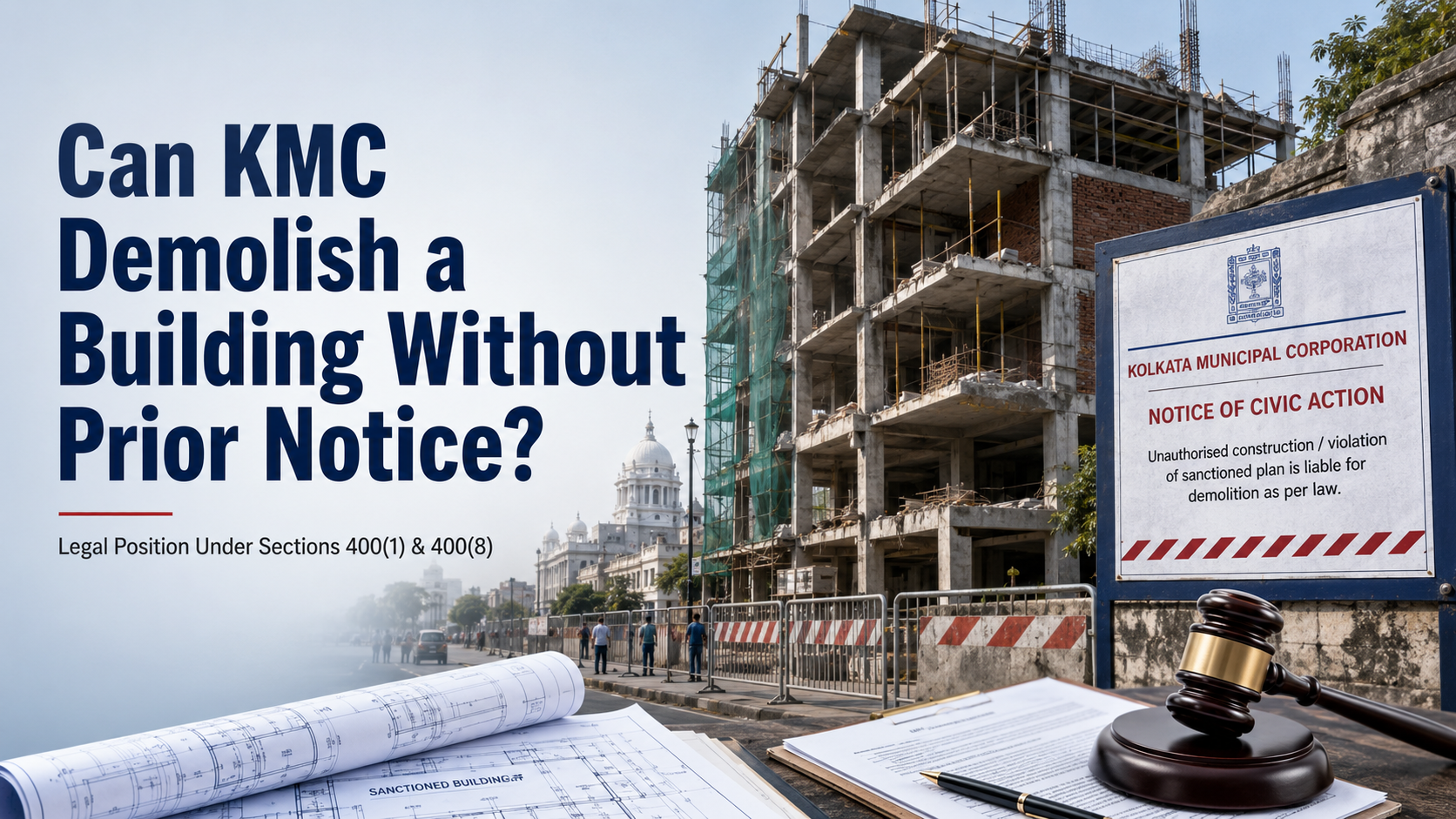

Unauthorized construction in Kolkata is not just a municipal issue. It can lead to demolition, sealing-like restrictions, disconnection of services, criminal proceedings, and heavy financial loss. Many property owners assume that once a building is occupied, assessed for tax, or partly completed, KMC cannot take serious action. That assumption is legally risky.
The Kolkata Municipal Corporation Act, 1980 gives KMC strong powers to deal with buildings constructed without sanction or beyond the sanctioned building plan. The most important provisions in this context are Section 400(1) and Section 400(8) of the KMC Act.
The key question is simple: Can KMC demolish a building without prior notice?
The answer is: normally, KMC must give notice and hearing under Section 400(1), but in urgent cases, KMC may take immediate demolition action under Section 400(8), provided legal conditions are satisfied.
What Counts as Unauthorized Construction in Kolkata?
A construction may be treated as unauthorized if it is:
- Built without a sanctioned plan
- Built beyond the sanctioned plan
- Built beyond the sanctioned plan
- Raised in violation of KMC Building Rules,
- Made by adding extra floors without approval
- Created by changing the approved use of a space, such as converting parking space into commercial use.
KMC’s own building sanction guidance states that construction without a valid sanctioned plan is liable to demolition. It also explains that after detecting illegal construction, KMC generally serves a stop-work notice and then proceeds under Section 400(1) or Section 400(8) of the KMC Act.
Section 400(1): Normal Demolition Process With Notice and Hearing
Section 400(1) applies where construction has started, is continuing, or has been completed without sanction, contrary to sanction, or in violation of the Act, rules, or regulations.
Under this route, the Municipal Commissioner may order demolition. But the law also protects the affected person by requiring a reasonable opportunity to show cause before the demolition order is made. The demolition order must also give reasons and allow a period of not less than five days and not more than fifteen days for compliance.
In simple words, Section 400(1) usually involves:
- Detection of unauthorized construction
- Notice or show-cause opportunity,
- Hearing before the concerned authority,
- Order for demolition, partial demolition, or possible retention where legally permissible,
- Appeal before the Municipal Building Tribunal within the prescribed period.
The KMC website also states that under Section 400(1), the case is disposed of after hearing, and the structure may be demolished, partly demolished, or retained depending on the degree of violation and structural safety.
Section 400(8): Immediate Demolition Without Prior Hearing
Section 400(8) is the more serious provision. It begins with a non-obstante clause, meaning it can override the normal procedure in appropriate cases. The provision allows the Mayor-in-Council to cause a building or work to be demolished forthwith if it forms an opinion that immediate action is required and records reasons in writing.
This is why KMC can, in certain situations, demolish unauthorized construction without giving the usual prior hearing under Section 400(1).
However, Section 400(8) is not meant to be used casually. KMC must show that:
- The construction is in contravention of the KMC Act
- Immediate action is called for
- The Mayor-in-Council has applied its mind
- Reasons are recorded in writing.
The Calcutta High Court has observed that if a person continues illegal or unauthorized construction despite a stop-work notice under Section 401, that itself may be enough for KMC to invoke Section 400(8).
Does KMC Always Need to Prove the Building Is Dangerous?
Not always. A common argument is that Section 400(8) can be used only when the building is physically dangerous. The Calcutta High Court has clarified that the provision does not say it can be used only when the structure is in a dangerous condition. Continued illegal construction in defiance of a stop-work notice can also justify action under Section 400(8).
That said, KMC cannot act mechanically. If the matter reaches court, KMC may have to justify why immediate demolition was necessary and whether the statutory authority recorded proper reasons.
What Happens If You Construct Beyond the Sanctioned Building Plan?
Constructing beyond the sanctioned plan can lead to serious consequences. Depending on the nature of violation, KMC may issue a stop-work notice, start demolition proceedings, refuse regularization, disconnect civic services, or initiate criminal proceedings.
Minor deviations may sometimes be considered for retention subject to rules, safety, and payment of applicable charges. But construction without sanction is treated much more strictly. In one judgment, the Calcutta High Court noted that minor deviations affecting extra open space may be regularized in suitable cases, but construction without sanction cannot be regularized because it is contrary to statute.
Stop-Work Notice Under Section 401
Section 401 allows KMC to order immediate stoppage of building work if construction is being carried out without sanction, contrary to sanction, or in violation of the Act or building rules. If the stop-work order is not followed, KMC may take further measures and may require police assistance to remove persons, workers, or assistants from the premises. KMC may also depute police or corporation staff to watch the premises, and the cost may be recovered from the person responsible.
Ignoring a stop-work notice can make the matter far worse because it may support action under Section 400(8).
Sealing, Service Disconnection, and Restrictions
In practical terms, unauthorized construction may also result in restrictions that affect occupation and use of the property. KMC issued a circular in April 2024 stating that no new water supply or drainage connection would be allowed, and existing water supply and drainage connections may be disconnected in cases involving unauthorized buildings, Section 400(8) action, Section 400(1) demolition orders, or additional floors built beyond sanction.
So even before or alongside demolition, the building may face serious operational problems, including loss of essential civic connections.
Criminal Action Under Section 401A
Unauthorized construction can also become a criminal matter. Section 401A applies where a person constructs or attempts to construct a new building or additional floors in violation of the Act or rules, and the construction endangers or is likely to endanger human life, corporation property, water supply, drainage, sewerage, road traffic, or may cause a fire hazard.
The punishment may extend to five years’ imprisonment and fine up to ₹50,000. The offence is also described as cognizable and non-bailable.
This means the risk is not limited to civil demolition. Owners, occupiers, promoters, consultants, financiers, or persons supervising the construction may also face criminal liability, depending on facts.
Can Payment of Property Tax Protect an Illegal Building?
No. Payment of property tax does not make an illegal construction legal. Section 400 itself recognizes that demolition action may proceed even if the building has been assessed for property tax.
This is important because many owners believe mutation, tax payment, electricity connection, or occupation gives legal protection. These factors may create records of possession or use, but they do not cure illegal construction.
Can an Unauthorized Building Be Regularized?
Regularization depends on the nature of violation. Minor deviations may be considered in limited cases if building rules, safety norms, mandatory open spaces, fire requirements, and other conditions are satisfied. But serious violations, extra floors, unsafe construction, and construction without any sanctioned plan are much harder to defend.
Courts have repeatedly treated illegal construction seriously because it affects planned development, public safety, civic amenities, traffic, drainage, fire safety, and the rights of other citizens. The Supreme Court’s concern about unauthorized construction has also been referred to by the Calcutta High Court in KMC-related matters.
Final Legal Position
KMC usually follows the Section 400(1) route, where notice and hearing are given before a demolition order. But KMC can invoke Section 400(8) for immediate demolition when urgent action is required and reasons are recorded in writing.
For property owners, promoters, and buyers in Kolkata, the safest approach is clear: never start construction without a valid sanctioned plan, never add floors beyond approval, and never ignore a stop-work notice. Once KMC action begins, the matter can quickly move from a municipal violation to demolition, service disconnection, and criminal prosecution.
FAQs
Can KMC demolish a building without notice?Yes, but only in limited situations. Under Section 400(8), KMC may take immediate demolition action if the Mayor-in-Council records reasons and finds that immediate action is required.
What is Section 400(1) of the KMC Act?
Section 400(1) is the regular demolition provision. It generally requires notice, opportunity of hearing, and a reasoned demolition order.
What is Section 400(8) of the KMC Act?
Section 400(8) allows immediate demolition of unauthorized work where urgent action is required and reasons are recorded in writing.
Can extra floors beyond the sanctioned plan be demolished?
Yes. Additional floors built without approval may be demolished and may also lead to criminal proceedings if safety or civic services are affected.
Can property tax payment save unauthorized construction?
No. Paying property tax does not legalize construction made without sanction or in violation of the sanctioned plan.
What is the punishment for unauthorized construction in Kolkata?
In serious cases under Section 401A, punishment may extend to five years’ imprisonment and fine up to ₹50,000.
Note: This blog is for general legal information only. For a live KMC notice or demolition case, the facts, sanctioned plan, inspection report, and order copy must be checked by a qualified lawyer.
If you have received a KMC notice, are facing demolition proceedings under Section 400 of the KMC Act, or need legal help regarding unauthorized construction, sanctioned building plans, stop-work notices, mutation issues, or property regularization in Kolkata, we can assist you. We provide legal support for KMC disputes, demolition matters, property due diligence, and builder-related issues. Contact us today for professional legal guidance before the matter becomes more serious.